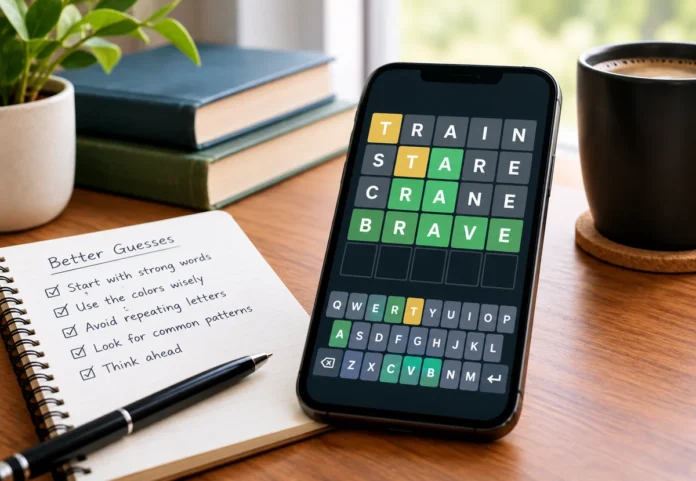
Wordle looks simple, but anyone who plays it daily knows that some puzzles feel easy and others feel impossible. The difference is often not luck. It is strategy. Players who solve the puzzle in three or four guesses are not smarter than everyone else. They just follow a clear plan.
In this guide, we will go through that plan step by step. You will learn how to use each guess, how to read the colors, how to handle tricky words, and how to avoid the mistakes that cost most players their streak. Everything is explained in plain language, so you can start using it in your next game. If you want a small clue after you finish playing, you can also visit our Wordle hint for today page.
The Basic Idea Behind Wordle Strategy
Wordle gives you six guesses to find one five-letter word. After each guess, the game gives you colors:
- Green means the letter is correct and in the right spot.
- Yellow means the letter is in the word but in a different spot.
- Gray means the letter is not in the word.
Every guess has two jobs. The first job is to get closer to the answer. The second job is to give you information. A good player balances both. Early in the game, information matters more. Later in the game, getting the answer right matters more.
If you remember only one thing from this guide, remember this: each guess should either help you learn something new or be a real possible answer. A guess that does neither is a wasted guess.
Guess 1: Start With a Strong Word
Your first guess sets the tone for the whole game. You know nothing yet, so the best move is to use a word with common letters and no repeated letters. Words like CRANE, SLATE, and STARE are popular because they test letters that appear in many answers.
We have a full guide on this topic, so if you are still choosing your opener, read our article on the best Wordle starting words. It explains which letters are most common, why balanced words usually beat vowel-heavy ones, and how to pick a word that suits your style.
Once you pick a starter, stick with it for a while. When you use the same first word every day, you get better at reading the colors and spotting patterns quickly.
Guess 2: Use What You Learned
Your second guess depends on what the first one showed you. There are three common situations.
If you got no colors
All gray tiles feel bad, but they still tell you a lot. You now know five letters that are not in the word. Use a second word with five completely new letters. If your first word was CRANE, a word like MOIST or LOUDS tests a fresh set of common letters. This is the best way to get clues quickly.
If you got some yellow letters
Yellow letters are in the word, but you do not know where. Try placing them in new spots in your second guess. Do not put a yellow letter in the same position again, because you already know it is wrong there.
If you got some green letters
Green letters are fixed. Keep them in the same place and try to build a real word around them. Think about which letters could fill the empty spots, and choose a word that tests new letters at the same time.
The goal of guess two is to get as many new facts as possible while still staying close to a real answer.
Guess 3: The Turning Point
By the third guess, most puzzles can be solved if you have used your clues well. This is the guess where you should stop experimenting and start narrowing down.
Ask yourself three questions:
- Which letters do I know are in the word?
- Which spots do I know are not possible for those letters?
- Which letters have I already ruled out?
Write these answers in your head, or even on paper. Then think of a word that fits all of them. If you can think of a word that fits, guess it. If you cannot think of one, try placing the known letters in different spots and see what real words appear.
If you are stuck at this stage, you can type your clues into our Wordle Solver to see which words are still possible. It is a good way to learn too, because you can see how the list gets smaller with each clue.
Guesses 4, 5, and 6: Finish the Job
If you reach guess four or later, the situation is more serious. You have fewer chances left, so every guess must count. Here are the main rules for the late game.
Only guess real possible answers. When you have only three guesses left, you should not test random letters unless the situation really needs it.
Count your remaining options. If only two or three words fit your clues, you can try them one by one. If there are many options, you need a smarter plan (see the next section).
Do not repeat gray letters. This sounds obvious, but tired players do it all the time. Always check that your guess does not include a letter you have already ruled out, unless you are doing it on purpose.
Stay calm. Most lost games happen because of panic, not because the word was too hard.
How to Handle Tricky Patterns
Some puzzles are hard because many words share the same pattern. For example, imagine you know the word looks like _IGHT. The answer could be LIGHT, MIGHT, NIGHT, RIGHT, SIGHT, TIGHT, or FIGHT. If you guess them one at a time, you could use up all your remaining tries.
The smart way to handle this is to use a sacrifice guess. This means you guess a word that is not the answer but tests several of the starting letters at once. A word like “FLORM” or “MOLTS” (anything that includes several of L, M, N, R, S, T, F) could show you which letter is right in one guess. Then your next guess is the real answer.
This is one of the most useful tricks in Wordle. It feels strange at first to guess a word you know is wrong, but it saves games that would otherwise be lost. Other common tricky patterns include _ATCH, _OUND, _ILLS, and _ASTE.
Understanding Double Letters
Double letters confuse many players. Words like SPEED, LLAMA, or ERROR have repeated letters, and the color rules can be tricky.
Here is what to remember:
- If you guess a word with two of the same letter, and the answer has only one, one of them will turn green or yellow and the other will turn gray.
- A gray letter does not always mean the letter is missing from the word. If the same letter shows up as green or yellow elsewhere in your guess, the gray one just means there is no extra copy.
- If you suspect a double letter, use it in your guess to test it. Do not wait too long, because it is easy to miss.
When you are stuck and nothing seems to fit, ask yourself: “Could this word have a double letter?” It is a simple question that solves many hard puzzles.
Using Position Information
Many players only think about which letters are in the word. Strong players also think about where letters are likely to be.
Some general patterns:
- Many answers start with S, C, B, T, or P.
- Many answers end with E, Y, T, R, or D.
- Letters like Q are almost always followed by U.
- Vowels often sit in the second or third position.
- Words ending in S are less common than you might think, because many answers are not plural forms.
These patterns are not rules, but they help you choose between possible words. When two words both fit your clues, the one that follows common patterns is usually the better guess.
Hard Mode Strategy
Hard Mode forces you to use every green and yellow hint in your next guess. This removes your freedom to test random letters, so you have to plan more carefully.
Some tips for Hard Mode:
- Choose a balanced starting word with common consonants, so you get useful clues from the beginning.
- Be careful with tricky patterns like _IGHT or _ATCH. In Hard Mode, you cannot use a sacrifice guess that ignores your clues, so you can lose games quickly if you guess wrongly.
- Think one step ahead. Before you guess, ask what you would do if the result came back mostly gray.
- Do not rush. Take extra time on guess two and three, because mistakes there are expensive.
Many players find Hard Mode more exciting because every decision matters. It is also a great way to improve your normal game.
Learn From Past Puzzles
One of the best ways to get better is to study old puzzles. When you look at earlier answers, you start to notice how the game likes to use certain letters, endings, and word types. You can also test your own strategy by asking yourself how you would have solved each puzzle.
You can browse all earlier solutions on our past Wordle answers page. Try picking five random days, covering the answer, and solving each one with your usual strategy. You will quickly see what works and what does not.
A related habit is to review your most recent game. Missed the last puzzle? Open yesterday’s Wordle answer and think about where your guesses went wrong. Learning from one mistake each day makes you a better player over time.
Mistakes That Ruin Games
Here are the most common mistakes, and how to fix them.
- Guessing too fast. Take a moment after each guess to read the colors properly. Most errors come from missing a clue.
- Ignoring yellow letters. A yellow letter tells you two things: it is in the word, and it is not in that spot. Use both facts.
- Repeating bad spots. If a yellow letter was in position three, do not put it in position three again.
- Chasing one idea. If your plan is not working, change it. Do not keep guessing similar words.
- Using rare letters too early. Letters like J, Q, X, and Z should wait until you have a reason to test them.
- Playing when tired. Your brain notices patterns better when you are fresh. A morning game often goes better than a late-night one.
- Giving up on the streak mentally. Even on guess five, a calm player can still win.
A Simple Step-by-Step Plan
If you want an easy routine, here is one you can follow every day.
- Start with the same strong opener.
- Read the colors carefully and note what you know.
- For guess two, use new common letters if the first guess gave you little.
- For guess three, look for a real word that fits all clues.
- If many words fit one pattern, use a sacrifice guess.
- Never repeat a letter you have already ruled out.
- Check your guess against every clue before you press enter.
This plan is simple, but it works. The more you follow it, the more natural it becomes.
Final Thoughts
Wordle is a game of patterns, and patterns can be learned. A good strategy is not about knowing thousands of words. It is about using each clue wisely, staying calm, and making smart choices when the board gets difficult.
Start with a strong opener, use your second guess to learn more, and make your third guess count. Practice a little each day, learn from your misses, and you will see your average drop faster than you expect. Good luck with your next puzzle!
Frequently Asked Questions
What is the best strategy for Wordle?
Start with a strong word full of common letters, use each result to narrow your options, and avoid wasting guesses on letters you already know are wrong.
How many guesses should a good player need?
Most strong players solve it in three or four guesses. Two guesses is rare and usually involves luck.
Is it better to guess real words or test letters?
In the early game, testing new letters is useful. In the late game, guess only real words that fit your clues.
What is a sacrifice guess?
It is a guess that you know is probably wrong, but it tests several possible letters at once. It helps you avoid losing guesses when many words share the same pattern.
How do I handle double letters?
Remember that a gray letter can still mean the letter appears once in the word. When nothing else fits, consider a double letter.
Does the strategy change in Hard Mode?
Yes. You cannot test random letters, so a balanced opener and careful planning matter even more.
Is using a solver cheating?
It is your game, so you decide. Many players use a solver to learn patterns after they finish, or only when they are truly stuck.
How can I improve quickly?
Play every day, use the same opener, review your mistakes, and study old puzzles. Small habits add up fast.